Volleyball Basics
Basic Volleyball Rules for Beginners: Serving, Hits & Scoring
In standard indoor volleyball, teams send the ball over the net and try to make it land in the opponent's court while preventing it from landing in their own. A team normally has up to three contacts to return it. Start by understanding a rally, then learn serving, boundaries and the rules your league actually uses.
How a rally and point work
A serve starts the exchange. Players return the ball until it lands, goes out or a fault ends the rally. Under rally scoring, the team that wins that rally receives a point whether or not it served. The next serve depends on which team won; match format and winning thresholds should be checked with the competition's rules.
For a beginner, watch one rally and ask three questions: who served, which team won the rally, and who serves next? That is more useful than memorizing an entire rulebook before touching a ball. School, youth, beach and indoor formats can differ, so name the format you are learning.
Up to three contacts: pass, set, hit
Three team contacts are a maximum, not a requirement. A typical sequence is a forearm pass toward a teammate, a set that prepares an attack, and a hit over the net. A controlled first or second contact can also go directly over. The team must not catch or throw the ball.
Standard indoor rules treat a block differently from the team's three contacts; the block contact does not count as one of those three. There are also specific consecutive-contact exceptions. Beginners should consult the governing rules rather than treating 'one touch per player' as a complete explanation.
The ball may contact any part of the body under standard volleyball rules, including a foot. That does not make kicking at a ball in a crowded room sensible, and it is not permission to import that technique into another game's approved instructions.
Serving and receiving
The server puts the ball into play from the service zone behind the end line, following the applicable rule requirements. An underhand serve can help a beginner work on direction and consistency, while other legal serving techniques belong in suitable volleyball facilities. Avoid introducing a powerful serve before the receiver can handle it.
On reception, aim to create a useful next contact instead of merely getting the ball away. Communicate early, stay balanced and direct a controlled pass toward a ready teammate. Do not practice serves toward windows, people who are not playing or fragile objects.
Boundaries, the net and rotation
A ball touching a court boundary line is in; a ball landing wholly outside is out. Other out-of-play situations include contacts with objects outside the legal playing area. Learn the actual court markings rather than using guessed furniture boundaries as official lines.
Net contact, reaching across, center-line movement and interference have detailed rules and exceptions. 'Never touch anything near the net' is not an accurate summary of every legal situation. Use the USA Volleyball rules to resolve a specific incident, and avoid unsafe reaches while learning.
In the usual six-player indoor format, a receiving team that wins the right to serve rotates. Service order, player positions and front-row/back-row restrictions add detail beyond the simple rally. A coach or beginner session can demonstrate the pattern on a marked court.
Practice at home without pretending it is a match
Start with the forearm platform shape or a gentle, controlled passing activity in clear space. Aim for a predictable ball to a ready partner, not a spike. Pause for retrieval rather than chasing a ball around furniture. USA Volleyball's simplified youth guidance can help adults choose developmentally appropriate learning tasks.
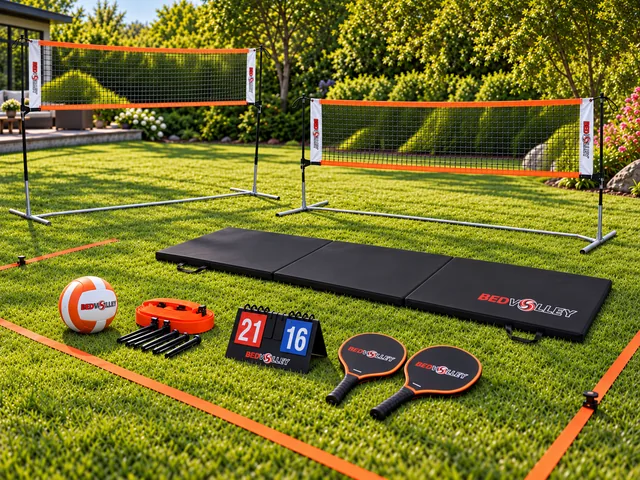
BEDVOLLEY is independent recreational net-and-ball play, not sanctioned volleyball. Its BedVolley/FloorVolley guidance uses a soft underhand serve, a maximum of three team touches and seated or kneeling play only. Read its own Rules & Safety rather than applying volleyball's legal techniques automatically to a bed or mat game.
Sources & further reading
Official references explain their own sports or guidance; they do not endorse BEDVOLLEY. Follow the current rules of the activity you choose.
Considering BEDVOLLEY?
Compare the three play modes and read the current Rules & Safety first. BEDVOLLEY is in development; final production testing, compliance review, specifications, price and launch date remain pending.
Join the BEDVOLLEY Launch ListFree development and launch updates. No payment, order or reservation.