Pickleball & Paddle Play
Basic Pickleball Rules: Serving, Kitchen & Two-Bounce
Pickleball begins with a serve to the diagonal service court. The receiving team must let that serve bounce, and the serving team must let the return bounce before either side volleys. Learn those two bounces and the seven-foot non-volley zone first; they explain much of what makes the sport different from a casual paddle rally.
Know the court and serve
An official pickleball court is 20 feet wide and 44 feet long for both singles and doubles. Each side has right and left service courts and a non-volley zone beside the net. The court lines identify legal areas; available space around the court is a separate facility consideration.
For a conventional volley serve, the paddle moves in an upward arc, contact is below waist level, and the paddle head must not be above the highest part of the wrist at contact. The rules also permit a drop serve with different requirements. Check the current USA Pickleball rules before deciding that every legal serve must look identical.
Serve from behind the baseline into the opposite diagonal service court. The serve must clear the non-volley zone, including its line. Service-position and foot-fault rules matter too; ask an instructor to demonstrate legal positioning rather than guessing from a highlight clip.
Understand the two-bounce rule
The receiver lets the serve bounce before hitting it. The serving side then lets the return bounce before hitting it. Once those two required bounces have happened, either team may hit a bounced ball or volley a ball out of the air, subject to the non-volley-zone rules.
Example: Maya serves diagonally to Lee. Lee lets it bounce and returns it. Maya's team waits for that return to bounce, then sends it back. Lee may now choose a legal volley from outside the kitchen or play the next bounce. Maya cannot rush forward and volley Lee's first return.
The kitchen is a non-volley zone
The kitchen extends seven feet from the net on each side. Its boundary lines are part of the zone. You may enter it to play a ball that has bounced; the restriction is against volleying while touching the zone, not against being there at all.
A volley can still be a fault if your momentum takes you into the kitchen afterward. Do not assume that hitting from outside makes the entire action legal. Learning to stop balanced outside the line is part of learning the shot, and a bounced-ball shot follows a different rule.
Traditional scoring and the doubles call
In traditional side-out scoring, only the serving team scores points. A commonly played game is to 11, win by two, though event formats can vary. Singles and doubles service procedures differ, and alternative scoring formats exist; agree on the format before starting.
In doubles, a score call gives the serving team's score, the receiving team's score and the server number. A call of 4–2–1 means the serving team has four points, opponents have two, and this is that team's first server in the service turn. The opening service turn has an exception: only one partner serves before the first side-out, commonly announced 0–0–2.
When the serving team wins a point, that server changes service courts. Usually both partners get a service turn before a side-out, except for the opening exception. Walk through this slowly on court; knowing who serves next prevents more beginner confusion than chasing difficult shots.
Recognize faults and separate home paddle games
Common faults include a ball landing out, failing to clear the net, violating a required bounce or committing a non-volley-zone fault. Stop the rally, check the rule and restart without a prolonged argument. Boundary lines are generally in, with the non-volley-zone line exception on the serve.
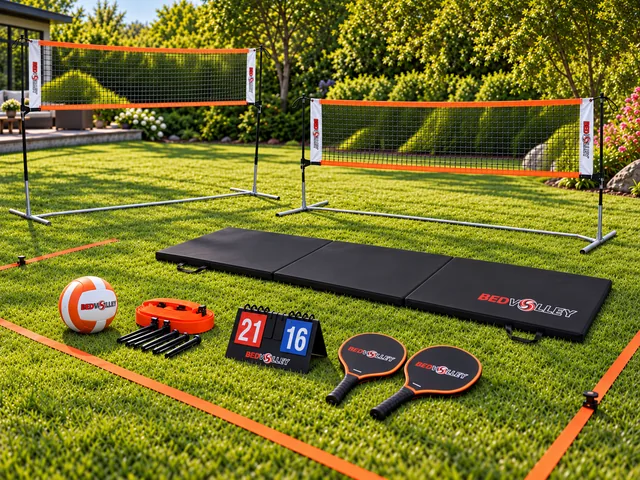
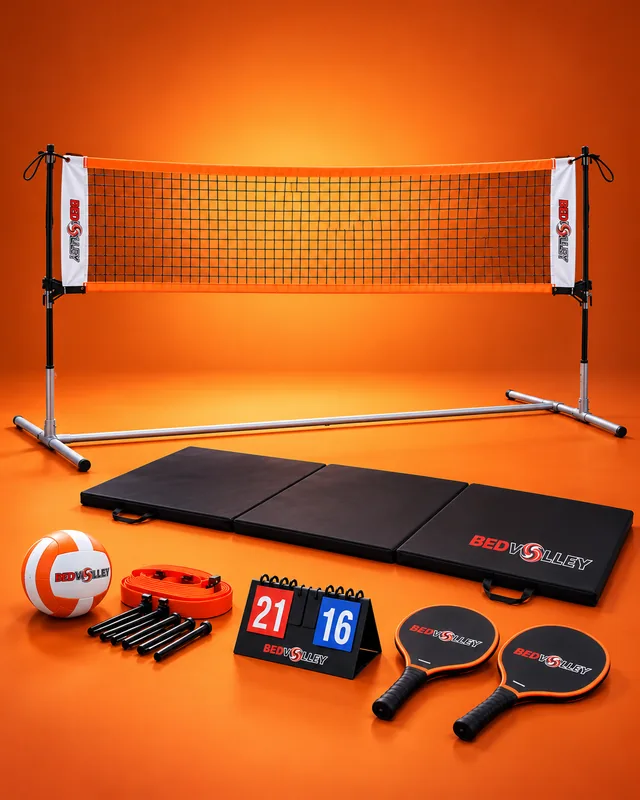
PaddleVolley is BEDVOLLEY's distinct raised-frame recreational paddle mode, not official pickleball. It does not claim an official court, regulation kitchen or competition rules. Do not assume pickleball scoring, serve techniques or dimensions are approved PaddleVolley instructions; use the BEDVOLLEY guide for that equipment.
Sources & further reading
Official references explain their own sports or guidance; they do not endorse BEDVOLLEY. Follow the current rules of the activity you choose.
Considering BEDVOLLEY?
Compare the three play modes and read the current Rules & Safety first. BEDVOLLEY is in development; final production testing, compliance review, specifications, price and launch date remain pending.
Join the BEDVOLLEY Launch ListFree development and launch updates. No payment, order or reservation.